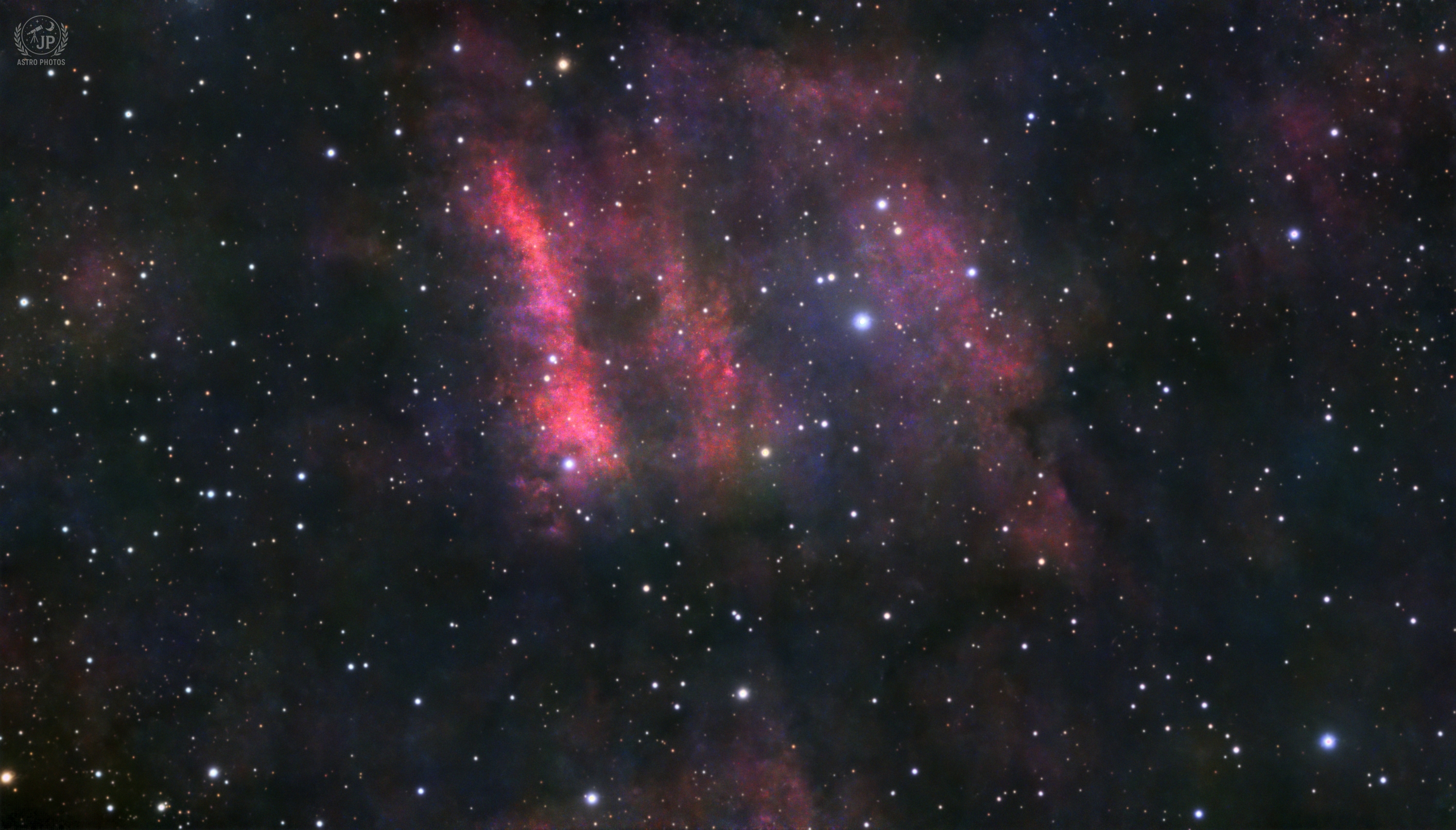
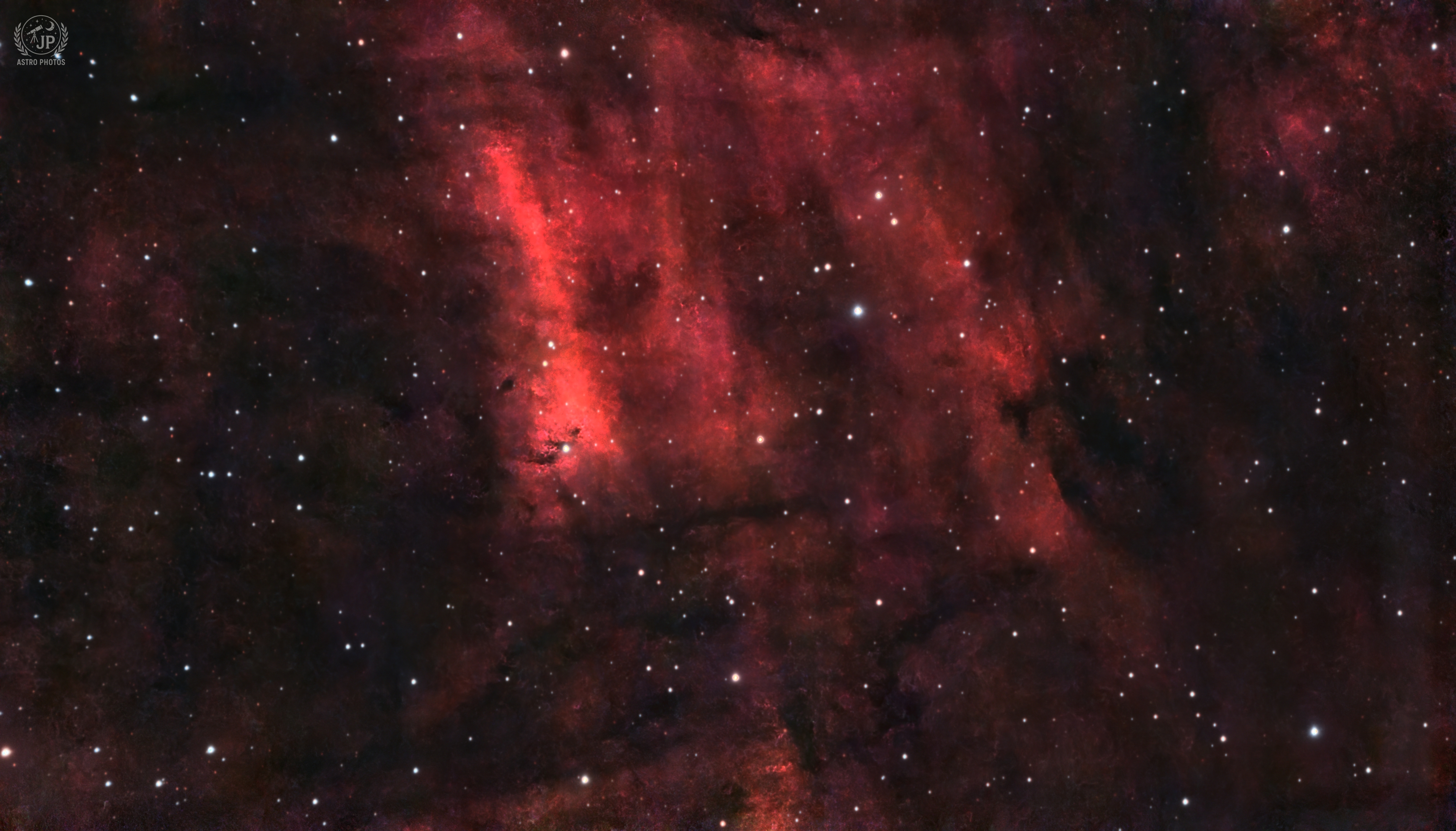
IC 5068 consists of glowing clouds of ionized hydrogen gas, but with relatively low surface brightness compared to the North America and Pelican Nebulae. This faintness and overshadowing location have kept it less celebrated, but not less interesting!
Also known as LBN 328 and Cederblad 183B, IC 5068 was initially thought to be about 1,600 light-years from Earth in the rich Milky Way star fields of Cygnus. However, recent measurements from the Gaia space observatory have helped pin down the distance to about 2,500 light-years.
It appears in the sky near the star Deneb – the tail of the Swan – though Deneb is not the source of its glow. In fact, IC 5068 is part of the same expansive star-forming complex as the North America and Pelican Nebulae, a giant ionized hydrogen cloud cataloged as Sharpless 2-117.
Like its neighboring nebulae, IC 5068 shines with a characteristic red hue from hydrogen atoms energized by young, massive stars in the region. All of these nebulae are physically connected: essentially, IC 5068 represents the southern extension of the North America/Pelican Nebula H II region, separated visually by intervening dark clouds.
In photographs, IC 5068 appears as a broad, textured patch of nebulosity with dramatic dark dust lanes crisscrossing its field. These obscuring bands of interstellar dust carve the nebula into distinct sections and even help delineate its boundary from the adjacent Pelican Nebula.
The pattern of dark streaks has a striking appearance – astronomy writer Stephen James O’Meara poetically dubbed IC 5068 the “Black Waterfall” for the look of inky rivulets cascading over the nebula’s luminous clouds. The dark lanes in IC 5068 resemble a curtain or waterfall of black silhouetted against the radiant hydrogen gas. When my wife saw this image, she commented that it looked like dark water was running down a pane of glass!
Such dust features represent dense, cool regions of the cloud where new stars may eventually form, even as nearby hot stars light up the surrounding gas.
https://cosgrovescosmos.com/projects/ic5068-shorgb-2025